
Access information in your language
If English is not your first language, interpreter services are available to help you.
Absentee chains of trusts (sub-trusts)
Examples of how the surcharge applies to chains of trusts.
Calculating the surcharge
A chain of trusts exists when the beneficiary of a trust is a trustee of another trust.
From the 2018 land tax year, the absentee owner surcharge on a chain of trusts is calculated on the absentee proportion of interests in the land subject to a trust.
This is the proportion of all the interests in the trust land that:
- an absentee natural person or corporation has in that land, directly or indirectly through one or more chains of trusts, that they do not hold on trust for another person
- a person has in the land, directly or indirectly through one or more chains of trusts, as trustee of an absentee trust that is a discretionary trust. This is because a beneficiary of a discretionary trust does not have a quantifiable interest in the trust.
To calculate the absentee proportion of interests in land, a unit holding in a unit trust is treated as an interest in the land which is held directly or indirectly by the unit trust.
The absentee proportion does not apply to the ultimate trust in the chain of trusts. The ultimate trust is the trust at the end of the chain. That means the trust that does not have beneficiaries that are a trustee of another trust.
Examples
These examples show how the absentee beneficiary’s proportion of interests in the land subject to a trust is calculated.
Example 1
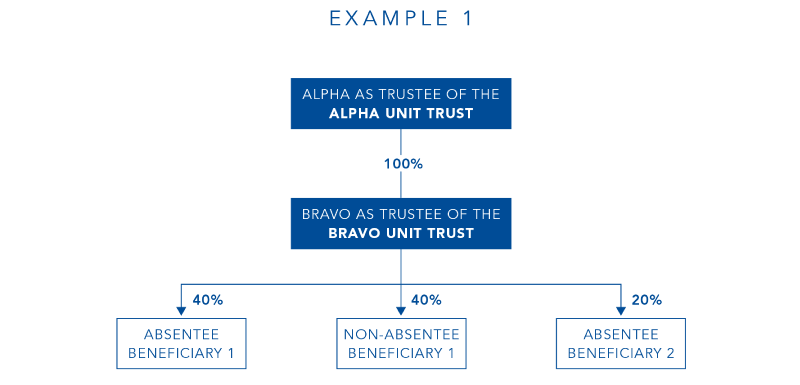
Alpha (as trustee for the Alpha Unit Trust), and Bravo (as trustee for the Bravo Unit Trust), are absentee trusts in of a chain of trusts. The absentee proportion of interests in land subject to the Alpha Unit Trust is calculated as follows:
- Calculate Absentee Beneficiary 1’s indirect interest in the land. Do this by multiplying Absentee Beneficiary 1’s interest in the Bravo Unit Trust (40%) by the interest held by Bravo as trustee of the Bravo Unit Trust in the Alpha Unit Trust (100%), i.e. 40% × 100% = 40%.
- Calculate Absentee Beneficiary 2’s indirect interest in the land. Do this by multiplying Absentee Beneficiary 2’s interest in the Bravo Unit Trust (20%) by the interest held by Bravo as trustee of the Bravo Unit Trust in the Alpha Unit Trust (100%), i.e. 20% × 100% = 20%.
- Add the amounts in step 1 and step 2, i.e. 40% + 20% = 60%.
The Bravo Unit Trust is the ultimate trust in the chain.
If Bravo owns other land as trustee of the Bravo Unit Trust, calculate the absentee owner surcharge based on the interests in the land held by the absentee beneficiaries, which is 60%.
Example 2
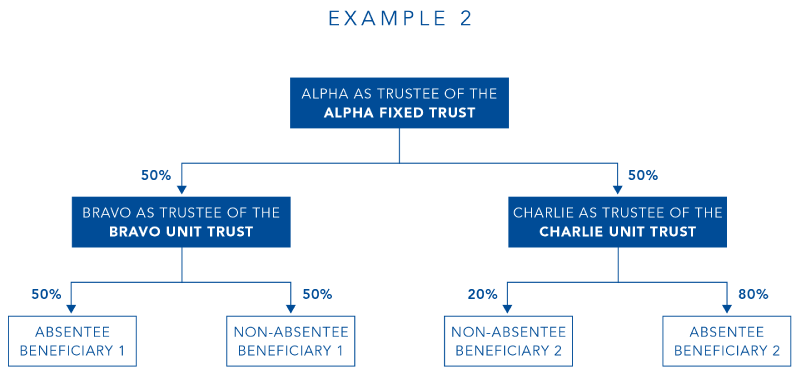
Alpha (as trustee of the Alpha Fixed Trust), Bravo (as trustee of the Bravo Unit Trust) and Charlie (as trustee of the Charlie Unit Trust) are all absentee trusts in a chain of trusts. The absentee proportion of interests in land subject to the Alpha Trust is calculated as follows.
- Calculate Absentee Beneficiary 1’s indirect interest in the land. do this by multiplying Absentee Beneficiary 1’s interest in the Bravo Unit Trust (50%) by the interest held by Bravo as trustee of the Bravo Unit Trust in the Alpha Fixed Trust (50%), i.e. 50% × 50% = 25%.
- Calculate Absentee Beneficiary 2’s indirect interest in the land. Do this by multiplying Absentee Beneficiary 2’s interest in the Charlie Unit Trust (80%) by the interest held by Charlie as trustee of the Charlie Unit Trust in the Alpha Fixed Trust (50%), i.e. 80% × 50% = 40%.
- Add the amounts in step 1 and step 2, i.e. 25% + 40% = 65%.
The Bravo Unit Trust and the Charlie Unit Trust are both ultimate trusts.
If Bravo and Charlie each own other land as trustee of their respective trusts, calculate the absentee owner surcharge using the interests in the land held by the absentee beneficiaries.
For the Bravo Unit Trust, the surcharge is calculated on 50% of the land. For the Charlie Unit Trust, the surcharge is calculated on 80% of the land.
Example 3
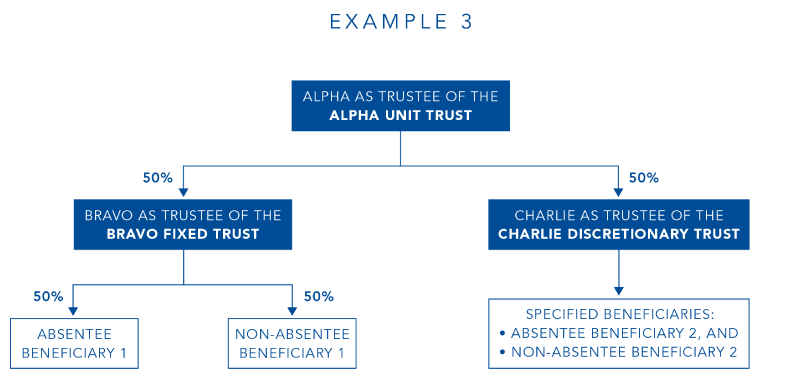
Alpha (as trustee of the Alpha Unit Trust), Bravo (as trustee of the Bravo Fixed Trust) and Charlie (as trustee of the Charlie Discretionary Trust) are all absentee trusts in a chain of trusts. The absentee proportion of interests in land subject to the Alpha Unit Trust is calculated as follows:
- Calculate Absentee Beneficiary 1’s indirect interest in the land. Do this by multiplying Absentee Beneficiary 1’s interest in the Bravo Fixed Trust (50%) by the interest held by Bravo as trustee of the Bravo Unit Trust in the Alpha Fixed Trust (50%), i.e. 50% × 50% = 25%.
- Identify the indirect interest in the land held by Charlie as trustee for the Charlie Discretionary Trust (which is an absentee trust because one of its specified beneficiaries is an absentee beneficiary). Do this by identifying the interest held by Charlie as trustee for the Charlie Discretionary Trust in the Alpha Unit Trust, i.e. 50%.
- Add the amounts in step 1 and step 2, i.e. 25% + 50% = 75%.
The Bravo Fixed Trust and the Charlie Discretionary Trust are both ultimate trusts.
If Bravo and Charlie each own other land as trustee of their respective trusts, calculate the absentee owner surcharge using the rule that apply to each trust type.
For the Bravo Fixed Trust, the surcharge is calculated on 50% of the land. For the Charlie Discretionary Trust, the surcharge is calculated on 100% of the land.
Example 4
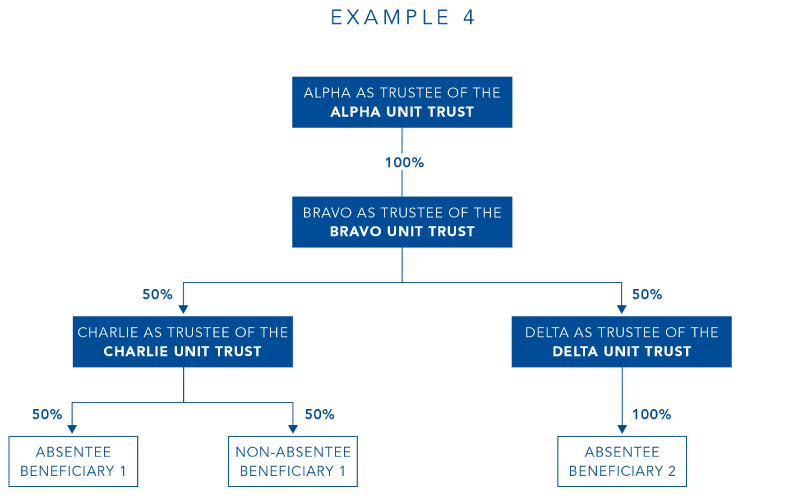
Alpha (as trustee of the Alpha Unit Trust), Bravo (as trustee of the Bravo Unit Trust), Charlie (as trustee of the Charlie Unit Trust) and Delta (as trustee of the Delta Unit Trust), are all absentee trusts and part of a chain of trusts. The absentee proportion of interests in land subject to the Alpha Unit Trust is calculated as follows:
- Calculate Absentee Beneficiary 1’s indirect interest in the land. Do this by multiplying Absentee Beneficiary 1’s interest in the Charlie Unit Trust (50%) by the interest held by Charlie as trustee of the Charlie Unit Trust in the Bravo Unit Trust (50%) by the interest held by Bravo as trustee of the Bravo Unit Trust in the Alpha Unit trust (100%), i.e. 50% × 50% × 100% = 25%.
- Calculate Absentee Beneficiary 2’s indirect interest in the land. Do this by multiplying Absentee Beneficiary 2’s interest in the Delta Unit Trust (100%) by the interest held by Delta, as trustee of the Delta Unit Trust in the Bravo Unit Trust (50%) by the interest held by Bravo as trustee of the Bravo Unit Trust in the Alpha Unit Trust (100%), i.e. 100% × 50% × 100% = 50%.
- Add the amounts in step 1 and step 2, i.e. 25% + 50% = 75%.
If Bravo owns other land as trustee of the Bravo Unit Trust, the absentee proportion is calculated as follows:
- Calculate Absentee Beneficiary 1’s indirect interest in the land. Do this by multiplying Absentee Beneficiary 1’s interest in the Charlie Unit Trust (50%) by the interest held by Charlie as trustee of the Charlie Unit Trust in the Bravo Unit Trust (50%), i.e. 50% × 50% = 25%.
- Calculate Absentee Beneficiary 2’s indirect interest in the land. Do this by multiplying Absentee Beneficiary 2’s interest in the Delta Unit Trust (100%) by the interest held by Delta as trustee of the Delta Unit Trust in the Bravo Unit Trust (50%), i.e. 100% × 50% = 50%.
- Add the amounts in step 1 and step 2, i.e. 25% + 50% = 75%.
The Charlie Unit Trust and the Delta Unit Trust are both ultimate trusts.
If Charlie and Delta each own other land as trustee of the respective trust, you can calculate the absentee owner surcharge using the interests in the land held by the absentee beneficiaries.
For the Charlie Unit Trust, the surcharge is calculated on 50% of the land. For the Delta Unit Trust, the surcharge is calculated on 100% of the land.