
Grouping and land tax
Related corporations may be grouped for land tax purposes.
Key information
Under the Land Tax Act 2005, there are certain circumstances where corporations are related to one another. When 2 or more corporations are related, they may be treated as a land tax group.
We combine the landholdings of each corporation in a group then assess them as if they were a single landholding owned by a single corporation.
Members of a land tax group are jointly and individually liable for the land tax payable by the group. As such, we are able to recover the land tax payable by the land tax group from any member of that group.
Corporations may be grouped for land tax purposes even if they do not own land in Victoria.
An absentee owner can be a member of a land tax group.
Further guidance is available in Revenue Ruling LTA-008 - Grouping of related corporations.
Ways corporations are grouped for land tax
For the purposes of grouping, the term ‘person’ includes a corporation. Further, a person or corporation is considered to control the composition of the board of directors if that person or corporation can appoint or remove all, or a majority of, the directors.
Two or more corporations can be related for land tax purposes in various ways.
These are where:
One corporation controls another
A corporation is related to another corporation if it:
- controls the composition of the board of directors of another corporation
- is able to cast, or control the casting of, more than 50% of the maximum number of votes that might be cast at a general meeting of another corporation
- holds more than 50% of the issued share capital of another corporation.
Common controlling interest
Corporations are related if a person (including a corporation) has, or persons together, have a controlling interest in each corporation.
There are 3 ways in which a person, or a set of persons together, may have a controlling interest in a corporation:
- The person, or those persons together, can control the composition of the board of directors of a corporation;
- The person is, or those persons together are, able to cast or control the casting of more than 50% of the maximum number of votes that might be cast at a general meeting of a corporation;
- The person holds, or those persons together hold, more than 50% of the issued share capital of a corporation.
Combined corporate and common shareholdings
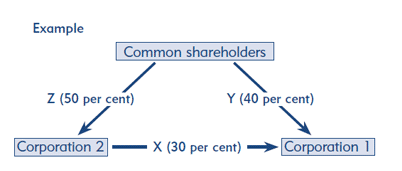
A corporation, together with its shareholders, may hold more than 50% of the issued share capital of another corporation. This occurs where both of the following conditions are satisfied:
- (a) X + Y > 50%
- (b) X + Z > 50%
where:- X is the shareholding in corporation 1 held by corporation 2 expressed as a percentage.
- Y is the shareholding in corporation 1 held by the shareholders common to both corporations expressed as a percentage.
- Z is the shareholding in corporation 2 held by the shareholders common to both corporations expressed as a percentage.
Indirect relationships
If one corporation is related to a second corporation and that second corporation is related to a third corporation, the first and third corporations are also related.
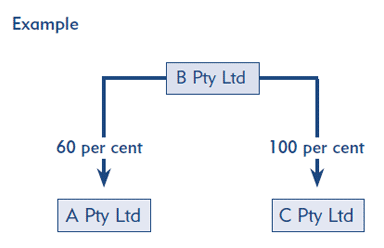
A forms a group with B because B holds more than 50% of the issued capital of A. For the same reason, B forms a group with C. Therefore A, B and C form 1 group as B is the common member of both groups.
Additional rules and exceptions
Share capital and control
- The term 'issued share capital' does not include shares which carry no right to participate in a distribution of profits or capital beyond a specified amount (i.e. preference shares).
- A person does not need to have a controlling interest in 2 corporations by the same means for a group to exist. For example, a person can control the composition of the board of directors of one corporation and hold more than 50% of the issued share capital of another.
Trustees, nominees and security interests
- Shares held or power exercisable by a trustee or nominee will be treated as also being held by the beneficial holder.
- Shares held, or power exercisable, by virtue of a debenture, or a trust deed securing the issue of debentures are disregarded.
- Shares held, or power exercisable, by a person or corporation, whose business includes the lending of money are treated as not held by that person or corporation. This applies where the shares are held or the powers exercisable merely as a security over a transaction entered into in the course of that business.