
Grouping
Businesses may be grouped for payroll tax if they share ownership, control or employees.
Key information
Grouping provisions ensure that businesses operating together are treated as a single entity for payroll tax. This helps prevent businesses from splitting their operations to gain unfair tax advantages, such as claiming multiple tax-free thresholds. Grouping can occur in several ways depending on how businesses are structured or connected.
Related corporations
Corporations are grouped under s70 of the Payroll Tax Act 2007 (the Act) where they are related bodies corporate within the meaning of s50 of the Corporations Act 2001 (Cth). This is commonly referred to as a holding/subsidiary relationship.
A corporation will be grouped with another corporation for the purposes of s70 if it meets one of these conditions:
- holds more than 50% of the issued share capital of that other corporation
- controls the composition of the board of directors of that other corporation
- can control more than 50% of the votes which can be cast at a general meeting of that other corporation.
Under s70, a group includes those corporations in a direct holding/subsidiary relationship as well as corporations with a:
- common holding company, or
- common ultimate holding company.
Example
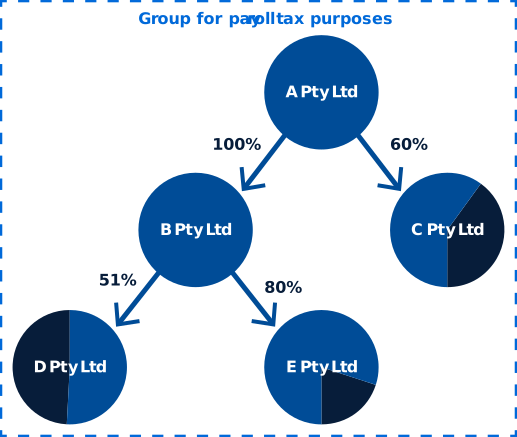
- A is grouped with B and C because it holds more than 50% of each.
- B is grouped with D and E as their holding company.
- All of the companies constitute a group because A is the common ultimate holding company.
Corporations that are related bodies are grouped, regardless of whether their holding company is overseas. Members of that group cannot apply to be excluded, even if their business activities are completely separate.
Non-trading trustee corporations are not grouped under section 70. These are companies that only act as a trustee and do not trade in their own right.
Grouping provisions apply regardless of location. Australian subsidiaries of overseas parent corporations may be grouped even if they are unaware of each other. Corporations should check with their parent corporation to identify other Australian subsidiaries.
Employees performing duties for another business
An employer will be grouped with another business if:
- one or more employees perform duties for another business carried on by the employer or another person
- one or more employees are employed solely or mainly to perform duties for another person’s business
- one or more employees perform duties for another business under an agreement, arrangement or undertaking that fulfils the employer’s obligations.
The Supreme Court held that the other business must have practical control over how the employee performs their duties. See Commissioner of State Revenue v Liquid Rock Constructions Pty Ltd [2012] VSC 329.
Example
Iron Petal Manufacturing Pty Ltd is a manufacturer of widgets. Hawthorne Advisory provides marketing, accounting, clerical and secretarial services to Iron Petal. While doing this work, Hawthorn Advisory’s employees of follow the general instructions of Iron Petal.
This means, Iron Petal and Hawthorne Advisory are considered a group. This is because Hawthorne Advisory’s employees are doing work for Iron Petal and are being directed by them.
Commonly controlled businesses
If a person or set of persons has a controlling interest in each of 2 businesses, the entities who carry on the businesses make up a group.
Controlling interest
It is the entities, not the individuals, that are grouped when a controlling interest in exists in both businesses.
Controlling interest depends on the type of entity operating the business. Under s72 of the Act, it may include:
- Where a business is conducted by a corporation, that person or set of persons:
- is the director of that corporation and can exercise more than 50% of the voting power at a directors’ meeting
- can instruct or influence a director who can exercise more than 50% of the voting power at a directors’ meeting, or
- can control more than 50% of the voting power attached to any class of issued voting shares.
- Where a business is conducted by either an incorporated or unincorporated body, that person or set of persons:
- constitutes more than 50% of the board of management, or
- can control the composition of the board.
- Where a business is conducted by a partnership, that person or set of persons:
- owns (beneficially or not) more than 50% of the capital of the partnership, or
- receives more than 50% of the profits.
- Where the business is conducted by one person, that person is the sole owner of the business.
- Where in the case of a set of persons, the persons are together, as trustees, the sole owners of the business.
- Where a business is conducted by a trust, that person or set of persons is the beneficiary in respect of more than 50% of the value of the interests in the trust.
In relation to trusts:
- Interests include entitlements to profits or capital distributions.
- Anyone who may benefit from a discretionary trust is deemed to hold more than 50% of the value of the interests and therefore has a controlling interest.
Indirect relationships
A controlling interest does not need to be direct. Control may be held through another a related entity or one in which a person has a controlling interest. This can occur:
- If corporations are related under s50 of the Corporations Act 2001 (Cth), a corporation is deemed to have a controlling interest in any business controlled by the other.
- If a person controls a business and that business controls another, then that first person is also deemed to control the second business.
Example
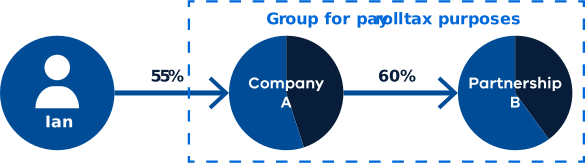
Ian has a controlling interest in Company A. Company A, has a controlling interest in Partnership B. Ian is therefore also deemed to have a controlling interest in Partnership B via his controlling interest in Company A.
- Where a trustee of a trust controls a business, a beneficiary with more than 50% of the value of the interests in that trust is deemed to control the business.
Example
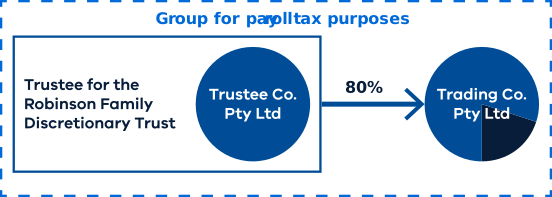
Lucy is a beneficiary of the Robinson Family Discretionary Trust with a controlling interest. Because the trust has an 80% interest (controlling interest) in Trading Co. Pty Ltd she is deemed to also have a controlling interest in Trading Co. Pty Ltd.
Same person owning 2 or more businesses
Grouping provisions do not apply when the same person or entity conducts multiple businesses.
There is only one employer so wages from both businesses must be combined in returns lodged by that employer. The same applies to a trustee owning 2 businesses, except where the trustee owns the businesses on behalf of 2 different trusts. In that case the grouping provisions must be applied.
Tracing of interests
A controlling interest exists if the entity has a direct, indirect or aggregate interest in the corporation – and the value of that interest exceeds 50%.
Entities
An entity is a person or set of associated persons which, under s73(4) of the Act, includes:
- a person and their spouse or domestic partner
- natural persons where the relationship between them is that of parent and child or siblings
- related corporations within the meaning of the Corporations Act 2001 (Cth)
- a natural person and a private company where the natural person is a majority shareholder or director of the company or of another private company that is a related body corporate of the company within the meaning of the Corporations Act 2001 (Cth)
- a natural person and a trustee where the natural person is a beneficiary of the trust (not being a public unit trust scheme) of which the trustee is a trustee
- a private company and trustee where the company or a majority shareholder or director of the company is a beneficiary of the trust (not including a public unit trust scheme) of which the trustee is a trustee
- natural persons if they are partners in a partnership
- private companies with common majority shareholders
- trustees with shared beneficiaries (not including a public unit trust scheme)
- a private company and a trustee where a related body corporate of the company, within the meaning of the Corporations Act 2001 (Cth), is a beneficiary of the trust (not including a public unit trust scheme) of which the trustee is a trustee.
Tracing interests in corporations
A direct interest exists where an entity can directly or indirectly exercise, control or influence the voting power attached to voting shares. Its value is the percentage of voting shares the entity can directly exercise or control.
An indirect interest exists where an entity has a direct interest in a corporation which is linked to another corporation.
Corporations are linked if they form a chain, with each link in the chain holding a direct interest in the next. Its value is calculated by multiplying the entity’s direct interest in the directly controlled corporation, with the percentage of each direct interest forming the link.
Example
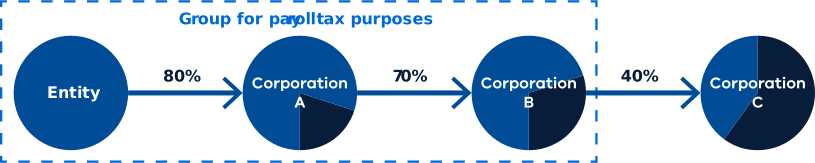
Entity has a direct interest in Corporation A.
Corporation A has a direct interest in Corporation B.
Corporation B has a direct interest in Corporation C.
Corporations B and C are linked to Corporation A.
Therefore, Entity has an indirect interest in both Corporations B and C.
The value of Entity’s indirect interest in Corporation B is 80% × 70% = 56%.
The value of Entity’s indirect interest in Corporation C is 80% × 70% × 40% = 22.4%.
Therefore, under the tracing of interests provisions, the entity forms a group with Corporations A and B because its direct interest in Corporation A and its indirect interest in Corporation B both exceed 50%.
An aggregate interest is the sum of an entity’s direct and indirect interests in a corporation. It occurs when an entity has:
- a direct and indirect interest in a corporation
- more than one indirect interest in a corporation.
The value of the aggregate interest is the total of all direct and indirect interests.
Example
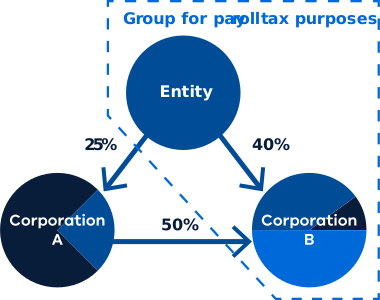
- Entity has a direct interest in A (25%) and B (40%).
- Corporation A has a direct interest in Corporation B (50%).
- Entity has an indirect interest in B (25% × 50% = 12.5%).
- Entity’s aggregate interest in B is 40% + 12.5% = 52.5%.
Entity therefore has a controlling interest in Corporation B. Entity and Corporation B form a group under the tracing of interests provisions.
Amalgamations
Where 2 or more groups share a common member, those groups will be amalgamated into a single group unless the Commissioner decides otherwise.
Example
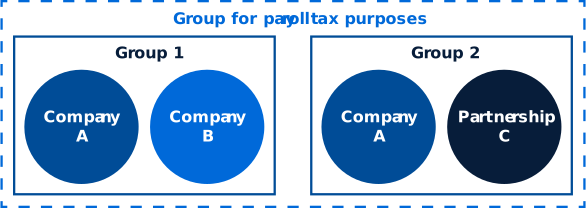
Company A is common to each group.
Therefore, Group 1 and Group 2 will be amalgamated and Companies A and B, and Partnership C, will form one group.
Where 2 or more group members together have a controlling interest in another business, all entities involved form a single group.
Example
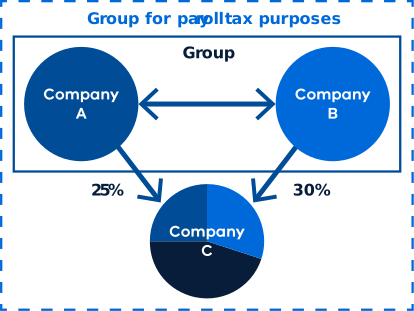
Company A and Company B form a group for payroll tax purposes.
Company A has a 25% interest in Company C.
Company B has a 30% interest in Company C.
Company A and Company B together have a controlling interest, 55%, in Company C. The 3 companies form a group for payroll tax purposes.
Interstate groups
Grouping applies regardless of location. Businesses may be grouped even if located in different states.
This affects total Australian wages and the deduction the group can claim in Victoria.
Example
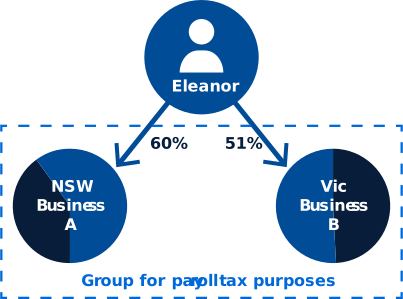
Despite the 2 businesses being located in different states, Business A and Business B will be grouped because Eleanor has a controlling interest in each.
Exclusions from the grouping provisions
The grouping provisions are intentionally broad. In recognition of this, the Act gives the Commissioner discretion to exclude a member from a group in certain circumstances.
Read about eligibility and the factors considered when you apply for an exclusion from grouping.
If you are unsure about eligibility, refer to Revenue Ruling PTA-031v2: Commissioner’s discretion to exclude a group or request a private ruling.
Registration requirements for groups
Each member of the group must be registered individually and as part of the group, even if they don’t employ staff.
Each group is allocated a unique registration number. Group changes, such as when entities begin and stop being part of a group, must be updated promptly in PTX Express.